

QUICK SUMMARY: Most small business owners do not plan to do everything themselves. It just happens. Over time, wearing every hat shifts you from leading your business to being buried in it. This article introduces the difference between Operator Mode (reactive, task-heavy, stuck) and Owner Mode (strategic, intentional, growth-focused), and walks through three practical shifts to help you make the transition: creating space to think, identifying one task you can stop doing, and building one simple system. The foundation for all three is a one-page marketing strategy framework, and it starts with the Chaos to Clarity Workshop.
Most small business owners don’t wake up one day and decide, “I’m going to do every single thing in this business.” It just… happens. One task turns into ten, one responsibility becomes five roles, and before you know it, you’re the marketer, the bookkeeper, the customer service rep, the project manager, the salesperson, and the person who remembers to order more printer ink.
But here’s the truth: Doing everything isn’t the same as leading. The first step to real growth is deciding to stop doing everything yourself.
There’s a fundamental shift that separates business owners who feel constantly behind from those who feel in control. It’s the shift from operator mode to owner mode, and it’s one of the most important mindset changes you can make at any stage of your business.
Operator Mode vs. Owner Mode: What’s the Difference?
Operator Mode
This is where most small business owners spend the majority of their time. It looks like:
- Doing everything yourself
- Constantly reacting to problems
- Jumping between tasks with no real plan
- Feeling like you’re always behind
- Working in the business, not on it
Operator mode keeps the business running, but it also keeps you stuck.
Owner Mode
Owner mode is intentional. It’s strategic. It’s where you make decisions that move the business forward instead of just keeping it afloat.
Owner mode looks like:
- Clear priorities
- Systems that support you
- Space to think, plan, and lead
- Delegating or eliminating tasks that drain you
- Working on the business, not drowning in it
Owner mode is where growth happens.
Why Small Business Owners Struggle to Stop Doing Everything Themselves
Because it feels necessary. When you’re the founder, the marketer, the customer service rep, the bookkeeper, the ops manager, and the person who remembers to order more printer paper, it’s easy to believe you have to do it all.
But here’s the hard truth: You can’t grow a business while doing everything inside it.
At some point, the very habits that helped you get started become the habits that hold you back.
Three Shifts That Help You Stop Doing Everything Yourself
You do not need a full rebrand, a new team, or a 40-page business plan. You just need a few intentional shifts, and a simple marketing strategy framework makes each one easier, clearer, and more sustainable. If you want a quick visual summary of these shifts, you can get the infographic here.
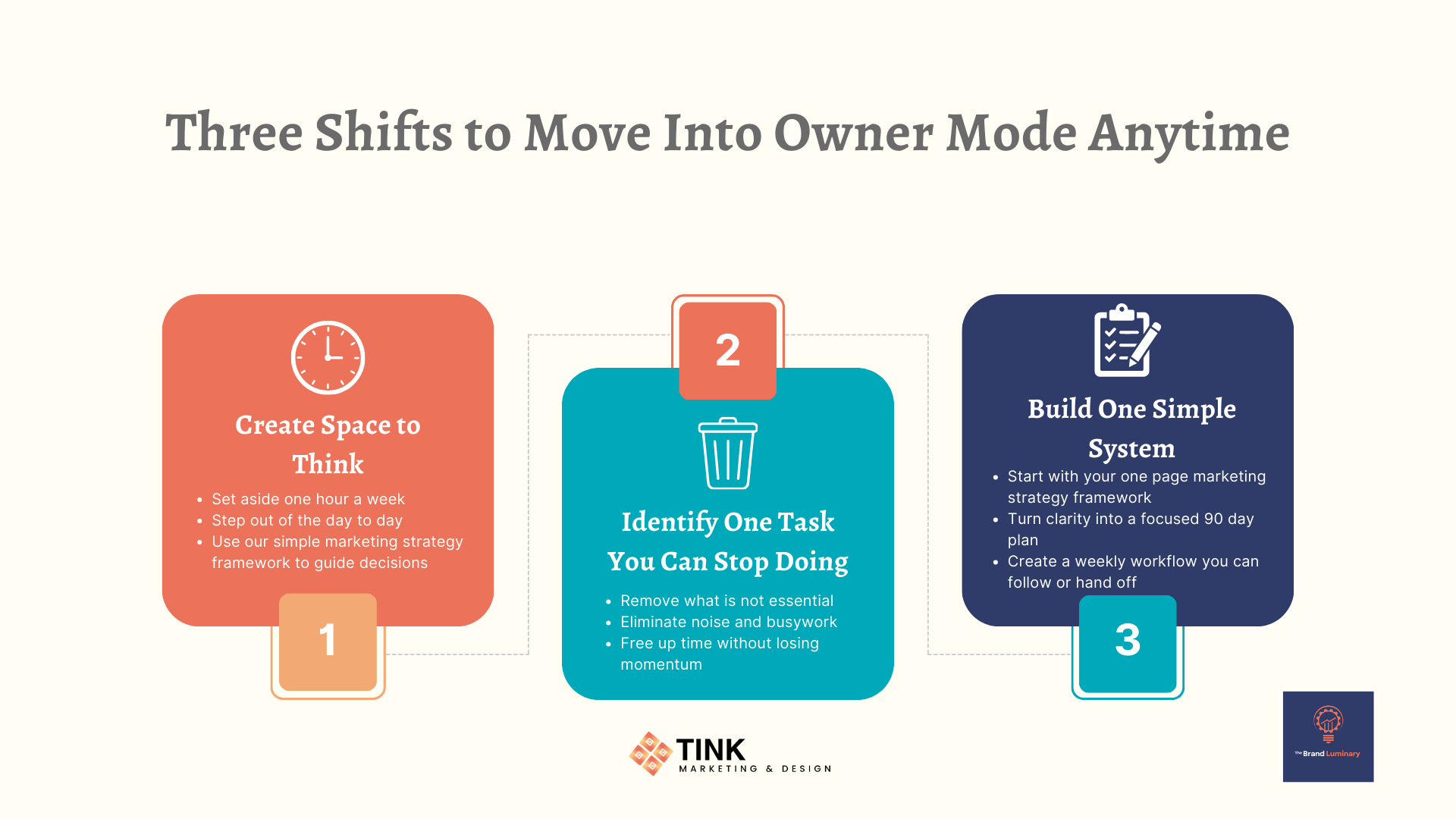
1. Create Space to Think (Even One Hour Helps)
When your marketing is random, reactive, or scattered across too many channels, it eats up your mental bandwidth. A simple marketing framework gives you:
- A clear plan
- A defined set of priorities
- A predictable rhythm
This means you can step away from the day to day without everything falling apart. That one hour of “Owner Time” becomes possible because your marketing is not chaos. It is a system.
2. Identify One Task You Can Stop Doing
Most small business owners are doing far more marketing tasks than they need to. A simple framework helps you see:
- What is essential
- What is optional
- What is noise
When you know the purpose of each marketing activity, it becomes obvious which tasks you can stop doing entirely. This is how you reclaim time without sacrificing results.
3. Build One Simple System
A system does not start with tools. It starts with clarity. And that is exactly what a one page marketing strategy framework gives you.
When your entire marketing strategy lives on one page, it becomes incredibly easy to turn that clarity into a 90 day marketing plan.
A one page framework helps you:
- Identify the right objectives for the next 90 days
- Choose the tactics that actually support those objectives
- Eliminate the noise and busywork
- Create a focused plan you can follow or hand off
Once you have a 90 day plan, building a simple system becomes almost effortless. Your plan becomes the blueprint for:
- A weekly workflow
- A repeatable content rhythm
- A checklist you can follow without overthinking
- A structure that keeps you consistent
Once your marketing has a system, it frees up your brain for higher level decisions. And that is the heart of owner mode: fewer decisions, more direction.
What Changes When You Stop Doing Everything Yourself
Small business owners who move into owner mode often describe the same results:
- More clarity, less chaos
- Better decisions
- More consistent marketing
- More predictable revenue
- A business that feels lighter instead of heavier
And perhaps most importantly: they feel like they are running the business instead of the business running them.
Choose Owner Mode Starting Now
You do not need a special date or a perfect moment to make this shift. You just need intention.
Small shifts compound into big changes.
If you are ready to stop doing everything yourself and start leading your business, this is your moment.
If you are ready to stop doing everything yourself and start leading your business, this is your moment. Start with our Chaos to Clarity Workshop, the hands‑on session where you will build your one-page marketing strategy framework and finally get clear on what matters most in your marketing. You will walk away with focus, direction, and a simple structure that supports you instead of overwhelming you.
Ready to take the next step and turn that clarity into a 90-day marketing plan? Continue inside The Brand Luminary League. But it all starts with the framework you create in the Chaos to Clarity Workshop.
Not sure where to start? Contact Us →
TOP QUESTIONS ANSWERED
Q: How do I stop doing everything in my business without things falling apart?
The key is to start smaller than you think you need to. You do not need to hire a team or overhaul your systems overnight. Start with one hour of dedicated strategy time each week, what this article calls “Owner Time.” Use that hour to look at your marketing and business activities and identify just one task you can eliminate or hand off. Most small business owners are doing far more than is actually necessary, and a simple one-page marketing framework makes it easy to see what is essential versus what is just noise. When you remove even one unnecessary task, you create breathing room, and breathing room is where better decisions get made.
Q: What is the difference between working in your business and working on your business?
Working in your business means you are executing: answering emails, fulfilling orders, handling customer service, posting on social media. It keeps things running but does not move the needle on growth. Working on your business means you are leading: setting strategy, evaluating what is working, making decisions about where to invest time and resources, and building systems that allow the business to run without you doing everything. Most small business owners get stuck in the first mode because it feels urgent and necessary. The shift to the second mode requires intentional time and a clear framework, but it is where sustainable growth actually comes from.
Q: What is a one-page marketing strategy and why does it help small business owners?
A one-page marketing strategy is a simplified, focused document that captures your most important marketing priorities, objectives, and tactics on a single page. For small business owners, the value is not just in having a plan. It is in the clarity that comes from building one. When everything lives on one page, it is easy to see what matters, what does not, and what to focus on in the next 90 days. It also becomes something you can hand off, delegate from, or use to onboard help without having to explain everything from scratch. It is the starting point for moving from reactive operator mode to intentional owner mode, and it is exactly what the Chaos to Clarity Workshop is designed to help you create.
#FractionalCMO #MarketingStrategy #BusinessGrowth #Leadership #CMO #Marketing #BusinessStrategy #ScaleUp #Innovation #SmallBusiness